

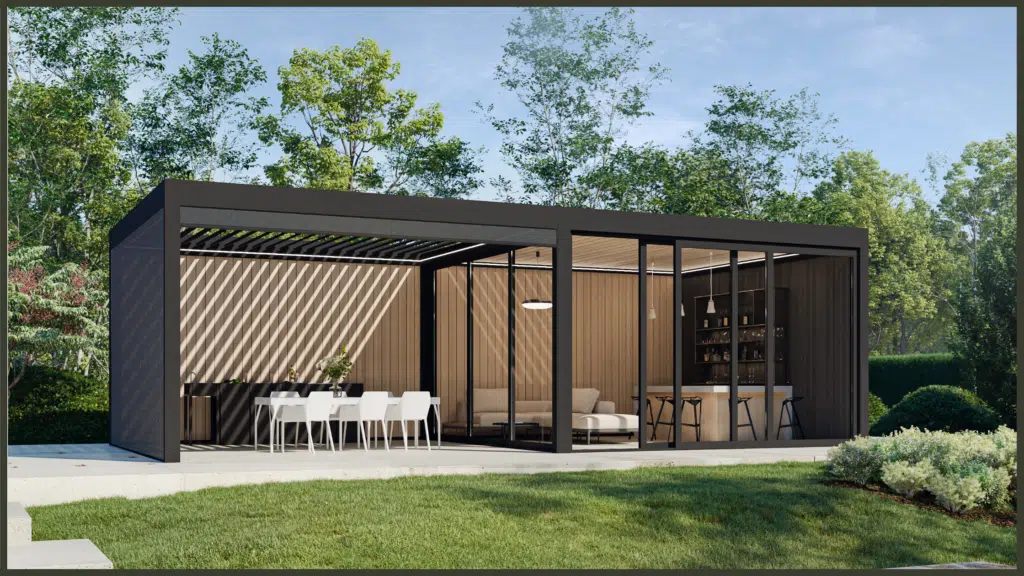
If you are considering a louvered or glass-roof pergola, the most common question is: “Do I need permission from the council?” Because these structures are generally considered “temporary” or “semi-permanent” outbuildings, the process is simpler than you might think.
Understanding Permitted Development
According to the UK Government’s Planning Portal, pergolas are usually categorised as “Outbuildings.” Under the Town and Country Planning (General Permitted Development) Order, you can build within the curtilage of your house without a formal application, provided certain conditions are met.
The Key Rules for Compliance
To ensure your project remains a Permitted Development, you should adhere to these primary constraints:
Height Restrictions:
- If the pergola is within 2 metres of your property boundary, the total height must not exceed 2.5 metres.
- If the pergola is more than 2 metres from the boundary, a height of up to 3 metres is allowed for a flat-roofed structure.
Location:
- The structure cannot be built forward of the “principal elevation” (usually the front of your house) facing a highway.
- It cannot be built on the side of a house within an Area of Outstanding Natural Beauty (AONB) or Conservation Area without permission.
Proportion:
- The total area of outbuildings (including sheds and previous extensions) must not exceed 50% of the total area of land around the original house.
When is Planning Permission Required?
You will likely need to submit a formal application if:
- The Building is Listed: Any structure within the curtilage of a Grade I or Grade II listed building usually requires Listed Building Consent.
- Designated Land: In National Parks, the Broads, or World Heritage Sites, the maximum area of a pergola situated more than 20m from the house is limited to 10 square metres.
- Raised Platforms: If your pergola is built on a deck that is more than 300mm (30cm) off the ground, the decking itself may require planning permission.
Summary of Authorities
For further reading and to verify the specifics of your project, we recommend consulting the following high-authority sources:
- The Planning Portal (Official Government Guide): The definitive source for planning rules in England and Wales.
- GOV.UK – Permitted Development Rights: Technical guidance on householder development.
- RICS (Royal Institution of Chartered Surveyors): Professional guidance on property boundaries and construction compliance.
Disclaimer: This guide is for informational purposes. While our pergolas are designed to meet standard UK regulations, we always recommend confirming with your local planning office or obtaining a Lawful Development Certificate before commencement.


